

Last updated October 2026
The best toys to donate are new, unwrapped and matched to a child’s age: soft toys and stacking toys for babies, blocks and pretend play for preschoolers, art kits and active games for school age kids, and practical gifts for teens. Skip used toys, toy weapons and small parts for children under 3.
Key takeaways
- Give new, unwrapped toys. Used toys are hard to check for safety and most drives cannot accept them.
- Match the toy to the age on the label. Small parts are banned in products for children under 3.
- Teens are the most often forgotten group. Practical gifts, art supplies and sports gear go a long way.
- Toys that need no shared language, like balls, blocks, puzzles and art supplies, work for every child.
- When you are unsure, a gift of money lets us buy exactly what children of each age still need.
Every gift helps a refugee child in Los Angeles. $25 gives school supplies to 2 kids.
DonateIf you are wondering what toys to donate this year, start with the child, not the store. A good donated toy is new, safe for the age it is given to, and easy to enjoy without instructions or a shared language. That last point matters more than most guides admit, because many of the children who receive donated toys are refugees who are still learning English.
At Little Smiles Foundation we have supported refugee children of all ages across the Los Angeles area since 2019. New toys, chosen for each child’s age, are at the heart of our Moments of Joy program. This guide brings together what to give at every age with the safety guidance from the U.S. Consumer Product Safety Commission and the American Academy of Pediatrics.
Why should donated toys be new and unwrapped?
New toys are safe, complete and dignified, and unwrapped toys can be checked and matched to the right child. Almost every toy drive, including ours, asks for both.
A used toy may be missing pieces, have worn seams or carry a recall you cannot see. A brand new toy comes with its age label and safety information intact, so we can match it to a child of the right age. It also sends a message. For a child who has left almost everything behind, opening something that was bought just for them is part of the gift.
Unwrapped toys let volunteers see what is inside, read the age label and pair each toy with a child. If you would like to add a personal touch, a short handwritten card is a lovely extra.
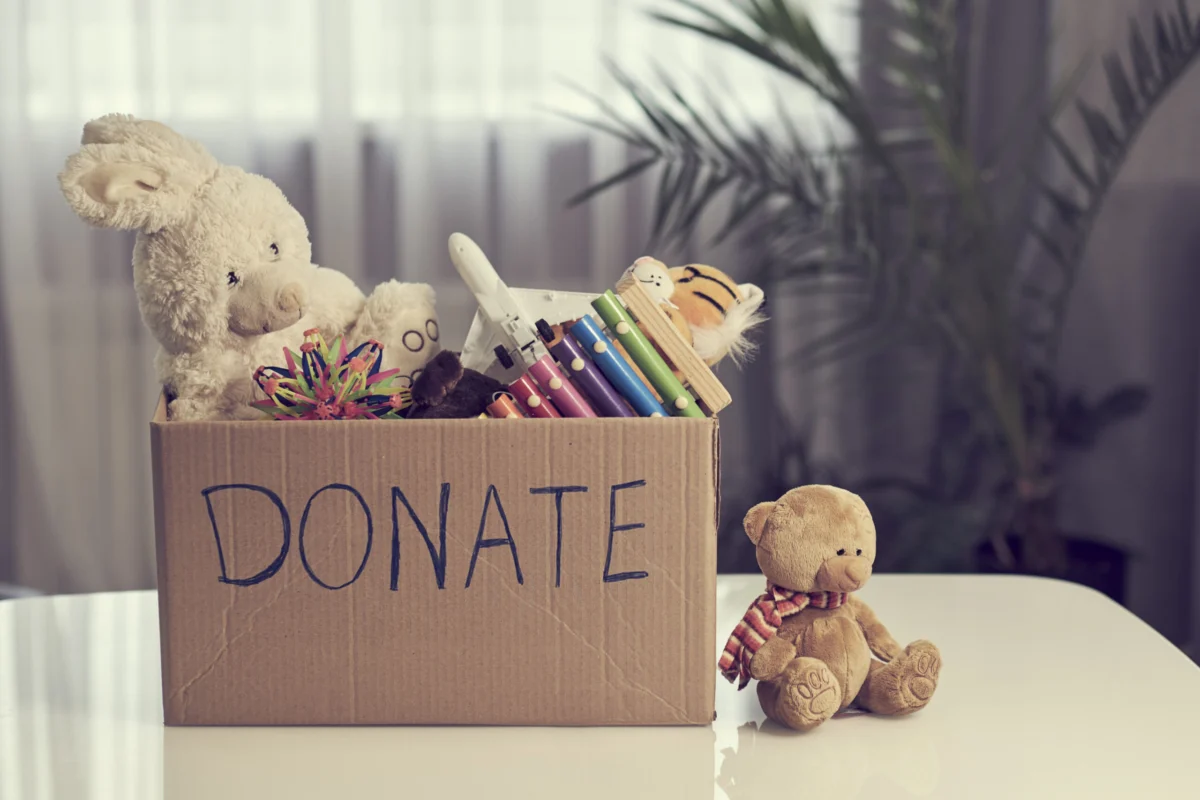
Which toys to donate for each age?
Use this table to pick the most needed toys to donate for each age group at a glance. The sections below explain each age in more detail.
| Age | Most needed toys | Why it helps | Avoid |
|---|---|---|---|
| 0 to 2 | Soft toys, board books, stacking cups, chunky blocks, rattles | Builds early motor skills and lets a baby play with a caregiver | Anything with small parts, button batteries or long strings |
| 3 to 5 | Large blocks, pretend play sets, simple puzzles, crayons, play dough | Pretend play and building help children make sense of a new world | Toys labeled 3+ with tiny pieces for the youngest in this group |
| 6 to 9 | Art kits, LEGO style sets, balls, jump ropes, card and board games | Creativity and active play build confidence and friendships | Electronic toys that need apps, accounts or constant charging |
| 10 to 13 | Craft and science kits, sports gear, chapter books, strategy games | Gives tweens a sense of skill and something to share with friends | Toys that feel too young, which can embarrass a tween |
| 14 to 18 | Art supplies, headphones, journals, backpacks, sports equipment | Practical, grown up gifts respect a teen’s age and goals | Generic toys meant for younger children |
What toys suit babies and toddlers (0 to 2)?
For babies and toddlers, choose soft, sturdy toys that are clearly larger than a child’s mouth. Good picks include soft toys, board books, stacking cups, chunky blocks, shape sorters and simple rattles.
The American Academy of Pediatrics advises families to “think large” so that every toy and every part is bigger than the child’s mouth. It also recommends stuffed toys that are well made, with parts attached tightly and seams that are secure. Avoid anything with loose ribbons or strings.
For this age, the most important thing a toy does is bring a caregiver and child together. A board book that a parent can read aloud in any language, or a set of stacking cups, often does more than a toy with lights and sounds.
What toys suit preschoolers (3 to 5)?
Preschoolers love toys they can build with and pretend with. Large building blocks, toy vehicles, doll families, play kitchens, simple puzzles, crayons and play dough are always welcome.
Pretend play is how young children work through big feelings and new places. A set of figures or a toy house lets a child act out a day at a new school, a trip on a bus or a family dinner. The AAP points out that the best toys need not be flashy or expensive, and that toys which encourage imagination and play with an adult do the most for development.
Some children in this group are still mouthing objects, so pay attention to age labels. A toy marked 3+ with very small pieces is fine for a five year old but not always for a three year old with a younger sibling at home.
What toys suit kids aged 6 to 9?
For kids aged 6 to 9, art kits, building sets, balls and games are the most requested gifts. They are old enough for more complex play and they love to make things.
- Art and craft kits with crayons, markers, sketchbooks and stickers
- LEGO style building sets and marble runs
- Balls, jump ropes and outdoor games
- Card games, dominoes and simple board games that are easy to learn by watching
- Picture books and early chapter books, including bilingual titles
Active toys suit this age well. A ball or a jump rope gets a group of children playing together even before they share a language, which is the idea behind our Play to Heal program of soccer, team games and open play.
What toys suit tweens (10 to 13)?
Tweens want gifts that feel grown up and let them show a skill. Craft kits, science kits, sports gear, chapter books and strategy games are good choices.
This is the age when a toy that looks too young can feel embarrassing. A friendship bracelet kit, a sketch set with good pencils, a basketball or a deck of cards tends to land better than a plush toy.
The AAP advises avoiding hobby kits and chemistry sets for any child younger than 12, because they can cause fires or explosions and may contain dangerous chemicals. Pick craft and building kits instead for the younger tweens.
What do teens need, the most often forgotten group?
Teens are the group most often left out of toy drives, so gifts for teens are some of the most valuable toys to donate. Think practical and personal: art supplies, journals, headphones, backpacks, sports equipment, hair and grooming kits, or a gift card where a drive accepts them.
A gift that treats them as the young adult they are, rather than as a small child, says that someone sees them.
Which toys need no shared language?
The most loved toys work without words. Children who are still learning English can enjoy them right away, with their siblings, classmates and new friends.
- Balls and active games. Soccer balls, playground balls and jump ropes need no instructions.
- Building toys. Blocks and building sets invite children to create together.
- Art supplies. Crayons, markers, paint and paper let a child express what they cannot yet say.
- Puzzles. Picture puzzles can be solved by any child at any reading level.
- Wordless and bilingual books. Picture books with few words, or in two languages, can be shared by the whole family.
- Music and rhythm toys. Simple drums, shakers and xylophones for younger children.
This matters because many refugee children have lived through very hard experiences. The National Child Traumatic Stress Network notes that refugee children may have experienced trauma related to war or persecution that can affect their mental and physical health long after the events. Play that is easy, shared and joyful is one of the simplest ways to help a child feel like a child again.
According to the UNHCR, children make up 39 percent of all refugees.
What should you not donate?
Do not donate used toys, toy weapons, or toys with small parts for children under 3. Also skip anything with loose button batteries or strong magnets, and toys that need apps or accounts.
- Used or opened toys. They are hard to check for safety and missing pieces.
- Toy weapons. Toy guns, swords and violent themes can be distressing for children who have lived through conflict.
- Small parts for under 3s. The U.S. Consumer Product Safety Commission bans small parts in toys intended for children under 3, because they can cause choking. A small part is anything that fits entirely inside the commission’s small parts cylinder, which approximates the throat of a child under three.
- Balloons, marbles and small balls for young children. CPSC rules require warning labels on toys that contain them, so read the label before buying.
- Button batteries and high powered magnets. The AAP warns that these can cause serious injuries if a child puts them in the mouth, nose or ears.
- Toys that shoot objects. The AAP notes they can cause eye injuries or choking.
- Toys that need apps, Wi Fi or accounts. Many families are still getting settled and may not have the devices or data plans to use them.
When does money go further than a toy?
A gift of money often goes further than a single toy, because we can buy in bulk and fill the gaps for each age group. It also lets us cover the things toys alone cannot.
Donated toys do not always match the ages of the children who need them. When you give money, we can buy for the age groups that need it most and add the school supplies and healthy food that go with them.
Here is what your gift can do right now:
- $25 gives school supplies to 2 kids.
- $50 gives healthy food to 3 kids for a week.
- $100 gives mental health support to 2 kids.
What will your gift become?
Prefer to give toys? Our 2026 Toy Drive page explains every way to take part, and you can also host a toy drive at your school or office. Our step by step guide on how to start a toy drive walks you through it, and our guide to donating toys in Los Angeles covers timing and how to choose a drive you can trust.
What should you check before you buy?
Run through this quick checklist before you buy toys to donate. It takes a minute and makes sure your gift reaches a child ready to play.
Before you buy
- It is brand new and still in its original packaging.
- The age label matches the child or age group you are buying for.
- There are no small parts if it is for a child under 3.
- It has no loose button batteries, strong magnets or long cords.
- It does not need an app, Wi Fi, an account or a subscription.
- It works without reading instructions in English.
- It is not a toy weapon or a violent theme.
- If batteries are needed, a pack of the right size is included.

Want more ways to help beyond toys? Read our guide on how to help refugee children for volunteering, giving and partnering ideas.
Frequently asked questions
What are the best toys to donate to charity?
New, unwrapped toys that match a child’s age: soft toys and board books for babies, blocks and pretend play for preschoolers, art kits and balls for school age kids, and practical gifts like art supplies or sports gear for teens.
Can I donate used toys?
Most toy drives, including ours, accept only new toys. Used toys are hard to check for missing parts, wear and recalls, and a new gift is part of the dignity of receiving one.
Which toys are usually rejected for donation?
Used or opened toys, toy weapons, toys with small parts for children under 3, and toys that need apps or accounts are the most common items drives turn away.
Should I wrap donated toys?
No. Please leave them unwrapped so volunteers can check the age label and match each toy to the right child.
What toys do teenagers need from a toy drive?
Teens appreciate practical, grown up gifts: art supplies, journals, headphones, backpacks, sports equipment and grooming kits. They are the group most often left out of toy drives.
Is it better to donate money or toys?
Both help. Money often goes further because we can buy in bulk, fill the age groups that are short and add school supplies and food. Toys bring the joy of a gift chosen by a real person.
What toys are good for children who do not speak English yet?
Toys that need no words: balls, blocks, building sets, puzzles, art supplies, music toys and wordless or bilingual picture books.
Where can I donate toys in Los Angeles?
You can give money for toys, host a drive or send a toy after emailing us first. Our Los Angeles toy donation guide explains each option and how to check that a drive is legitimate.
Give a refugee child a reason to smile
The right toy at the right age can help a child who has lost so much feel like a child again. Give today, or join our Toy Drive and bring new toys to refugee children in Los Angeles.